One of the jobs I always wanted was to be a video game reviewer. Getting paid to play video games all day and then getting to pick it apart, man, that’s the life. Instead of life giving me the chance I decided to take a whack at it back in deuce double-ought eight (2008). It was just a little blog named E-tank (after the Mega Man item) and I co-wrote it with my friends Finny and Tom. Ultimately, I didn’t commit the time necessary and after 4 reviews (2 by myself) it fell into obscurity. Instead of letting those reviews go to waste (I am shutting the site down due to inactivity) I decided this would be the perfect resting place for them. So, here is my two game reviews:
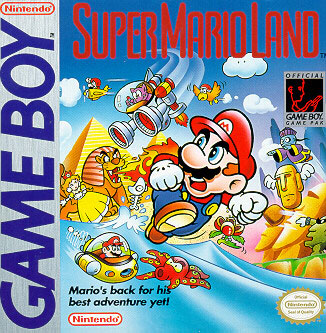 Super Mario Land
System: Game Boy
Released: August, 1989
Genre: Platformer
I decided for my first review to look at Super Mario Land for the Game Boy. Why have I chosen such an old and semi-forgotten title? I think the answer is because it’s an old and semi-forgotten title. The game was a launch title back for the Game Boy way back when I was only 2 years young. It is looked at as kind of a bastard child of Mario games. It adheres to the platforming aspect of Mario games, but detours in many areas.
There is no Princess Toadstool (Peach) in this game; you are hero to Daisy. Apparently when Mario leaves “World” and travels to “Land” he has another princess on the side. What a needy guy. Another deviation is the use of the “fire” flower. It doesn’t shoot fire like in previous Mario games, it shoots balls…superballs. Unlike the fire, these bounce all around the screen . I don’t know what the exact thinking was, maybe it had to do with coding fireballs? Mario also commandeers some vehicles in this game which is unlike any previous or future games in the series. He is the pilot of both a submarine type vehicle and a plane in two separate levels.
The enemies in this game are a little esoteric as well. There are the normal goombas, but aside from that there are completely new baddies. There are turtles who turn into bombs when stomped on, two version of Easter Island heads, and some kinda jumping vampire, zombies with knives. For the life of me I have no idea what they were supposed to be.
Now onto the actual game! First off, this game is hard and I mean merciless. The hit-boxes are all messed up and you will die many, many times. I think that is why they hand out lives like they are going out of style. The physics are all kinds of backwards and you tend to fall about 4 times faster than you do jumping up.
These very points that may seem like negatives against the game are actually redeeming qualities. I mean, games these days have large stories, and many of them want you to succeed so you can listen to the rest of their well-crafted tale. This game couldn’t care less. You know you will eventually save the princess. Story told. Now die!
This game is incredibly short. One could finish in under a half-hour if you were pretty good. It only has 4 worlds and 5 bosses. Each world has 3 levels. While the game lacks in length, the amount of difficulty that this game racks up will make you happy it is only as long as it is. Many times I found myself so frustrated by the short straw I had been dealt that my head was about to explode and blood spill everywhere.
Closing comments:
Due to the difficulty, finishing the games gives you a sense of accomplishment – a very nice feature to any game. Even though it deviates from the series, it is still Mario at it’s core and you still get the Mario feeling. It was the first portable Mario too; so, they did a pretty good job considering the constraints of the Game Boy and it being a launch title. If you can get past the weirdness of the game and the extreme punishment you are sure to be dealt, then please play the game. It is and was an instant classic.
Score:
7.5/10
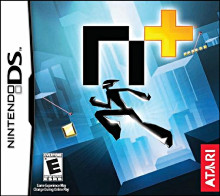
N+
System: Nintendo DS
Released: August 26, 2008
Genre: Platformer/Puzzle
I’ll start the review with a little history lesson. This original game “N” started out as a free online flash game. It was gained quite a cult following. It was one of those games that caught the attention of some game companies as some flash games often do. N+ is the result of that. It was released on XBLA, PSP, and Nintendo DS. History lesson finished. Review commencing.

First off this game is a 100% perfect handheld game. It knows exactly what it’s trying to be and doesn’t go beyond that. The premise is that you are a ninja-type guy who collects gold while avoiding hazards. To actually finish a level you have to activate a green crystal and then head to a door that it opens. The game objectives are very simple and there is no story to muck it up. I am a big fan of story, but sometimes you just want to play something, quick. You have a 15 minutes on a bus ride, waiting in line for a movie, or a meeting. It has episodes that contain 4 levels each. Of course as the episode number increases so does the difficulty.
As far as game play is concerned the controls are tight and it does exactly what it tells you to. There was never a time I felt that the game “cheated.” If I died it was due to my own movements. That is a large plus to me. In some platformers, I feel as if some deaths are out of your hands. For example, Mega Man, the games are hard as hell and no matter how fast your reaction times, sometimes you just can’t win. This game really puts the responsibility on the player.
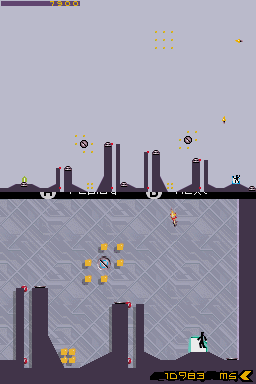 The game hearkens back to the platformers of old and does so with grace and polish. The game is really “cool.” Let me explain. It doesn’t have Bowser on a surfboard, playing a double-necked guitar with notes coming out, wearing shades, in front of a pot leaf, and in front of a cross or anything, but it does have a color-scheme and character animations that are slick. The design is minimalist with technorati undertones. Like I said “cool.” They took only the platformer elements of a game, stripped them out, and made n+. It is fantastic. It’s a game and doesn’t try to pass itself off as anything more.

The difficulty in this game is up there with the best of them such as previously mentioned, Mega Man. You will be re-doing some levels 15-20 times. It is frustrating, but provides almost instant gratification because at the end of 4 levels you pass an episode and see it get checked off. I do however think some of the difficulty is mismatched. I played episodes further on in the number scheme and found them easier then some of the earlier ones. I know with so many levels it’s hard to quantify them and to be honest it doesn’t affect gameplay at all, it just seemed out of place to me. If you like difficult games that reward and give you a good challenge this is for you. Personally, I like when games hand my ass to me on a silver plater. It causes me to really focus and I love it. I guess I am what you call a “hardcore” gamer in modern terms. I was raised on the likes of Mega Man and Contra. Those games didn’t have a heart, and I loved them for it.
Closing Comments:
The game plays like it was designed for handhelds. It is a quick pickup, with plenty of levels and challenges that will have you throwing your DS against the wall. It is one of those games you always want to have on hand if only to take a break or unwind. It is a perfect time-killer. The number one feature of this game is that is is fun. I know that sometimes gets left out of modern games, but it is just plain fun. This is a definite must-have title for DS owners.
Score:
8.5/10